The Boleyn Family's Rise at Court
The King's CurseThe Boleyn family's rise at court changes more than who stands nearest to Henry VIII: it unsettles the rituals of rank, the place of Katherine of Aragon and her daughter, and the balance of advice around the Crown. Through Anne Boleyn's advance from lady-in-waiting to a figure who can hold court and defy established precedence, the family becomes a visible force in a struggle over royal favor, succession, and authority.
A breach in the court's order
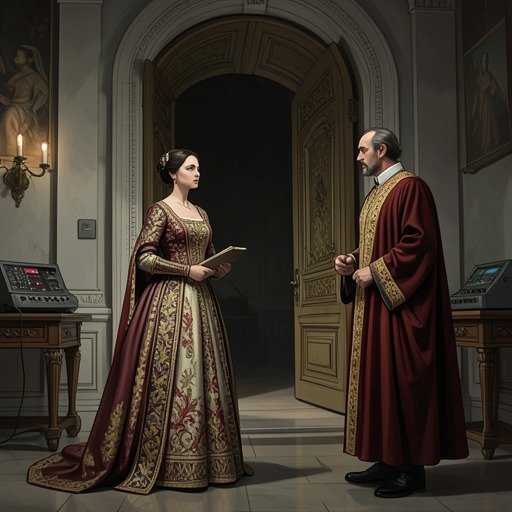
Anne's ascendancy first registers in a public ceremony. After Katherine has taken leave of the king and the ladies prepare to follow her from the hall in order of precedence, Anne remains behind among the most favored men at court. Margaret Pole initially reads the moment as a breach of etiquette and is ready to help Anne avoid embarrassment. Then she recognizes that Anne's stillness is deliberate: she does not join the queen's train, and Henry permits her to remain. The court's customary hierarchy has not merely been overlooked; the king's acquiescence gives the departure its political force.
Katherine leaves with Princess Mary Tudor, Mary Tudor Brandon, and the other women following in silence, while Anne's position is confirmed by her separation from them. The contrast is particularly sharp because Anne had once been remembered as a child delighted to serve Princess Mary Tudor in France, and later as a young woman whose entry into Katherine's service pleased her father. By autumn 1528, Margaret finds it difficult to reconcile that earlier place with Anne's new authority: the former attendant now dominates attention, while the queen and king are estranged.
The change is also read as a signal about foreign policy. Montague suggests that Anne's public precedence may be meant for the French ambassador as much as for the English court. Anne had spent years at the French court and had helped bring about Princess Mary Tudor's French betrothal; her elevation could therefore announce that Henry intended to favor the French connection rather than renew friendship with Spain, Katherine's homeland. In this reading, a courtly slight carries diplomatic meaning, making the queen's diminished position a public indication of the king's chosen direction.
From favored presence to rival court
Anne's influence becomes harder to treat as a single ceremonial provocation when she establishes a following of her own. Margaret hears from her dressmaker that Anne is staying at Suffolk House, the residence of Mary Tudor Brandon and Charles Brandon, and that visitors come daily while dances take place every night. The dressmaker presents this as a fashionable attraction; Margaret understands it as Anne holding court. She doubts that Mary Tudor Brandon would have invited Anne to take over her house, and suspects that Charles Brandon has enabled the arrangement. The setting gives Anne a center of social gravity beyond the queen's rooms.
The Boleyn family's growing visibility is reinforced by the Howard connection. At Greenwich Palace, the Boleyns and their kinsman Thomas Howard are described as moving through the palace as though it were their own household, while avoiding Katherine's rooms. The older noblemen continue to show the queen formal respect, but their caution contrasts with the Howard family's evident access and expanding influence. Anne is also reported to have declared that she would never serve Katherine again. Margaret dismisses the threat at first, yet the refusal matters because it marks a break with the queen's household at the same time that Anne's family is increasingly present elsewhere at court.
The court's shifting attention also rests on the unresolved question of succession. Henry's surviving daughter, Princess Mary Tudor, is twelve in autumn 1528, and Margaret describes her as intelligent, disciplined, and carefully educated. She cannot shield the princess from the visible estrangement of her parents or from the prospect that Henry may deny the validity of his marriage to Katherine. At the same time, the king's attention to other women makes the possibility of a male heir central to the court's calculations. Anne's rise thus unfolds in a setting where a woman's closeness to the king may affect not only precedence but the future standing of the queen's daughter.
Family power and the queen's displacement
The change in courtly power becomes explicit after Thomas Wolsey dies on the road to London in autumn 1530, before he can face trial. The Boleyn siblings celebrate his death before the court in a masque, while Margaret regards the display as evidence of a new and alarming order. Wolsey's fall removes a dominant royal adviser; the Howard family's presence, and its association with the Boleyns, gives the shift a dynastic and familial character. Margaret sees Thomas More as the king's remaining trustworthy counselor, though even he is burdened with royal business and struggles to maintain time for his own work.
Katherine's public treatment shows how the new alignment affects the queen's position. Courtiers continue to bow to her and listen when she speaks, recognizing her as both a Spanish princess and Queen of England, even as they avoid openly challenging Henry. The Boleyns and Thomas Howard are singled out as exceptions to this pattern of deference. Their absence from Katherine's rooms, combined with their presence throughout the rest of Greenwich Palace, makes the queen's isolation legible without requiring her formal dignity to disappear at once. Her supporters' respect and the family's growing access exist side by side, revealing a court divided between customary recognition and the power of royal favor.
The earlier dispute over Katherine's marriage gives this conflict a legal as well as personal history. Margaret had once been pressed to affirm that Prince Arthur and Katherine had been put together as required, and later faced the claim that Katherine's insistence that her marriage had not been consummated would endanger the Tudor house. Under Henry VIII, the validity of Katherine's marriage again becomes a contested basis for succession and authority. Anne's advancement takes place within that struggle, although the rise of her family and the legal case against the queen are not identical matters.
From court faction to royal authority
By the time the clergy surrender to Henry, the rise of a court family has become part of a much larger transfer of power. Montague tells Princess Mary Tudor that the Church has yielded to the king, that the Pope is to be disregarded in England, and that Thomas More has returned the Lord Chancellor's seal and gone home. The news leaves the princess to understand that her father's conflict with her mother has expanded into a claim over the Church's government, laws, and courts. The Boleyn family's prominence belongs to this political realignment, but the consequences reach far beyond household influence.
Montague then proposes a plan to defend Katherine and the princess. He hopes to take Geoffrey Pole with him to Calais, where Geoffrey could reach Reginald Pole, report on their friends and kinsmen, and carry messages to the Pope and the King of Spain. Montague believes that a decisive papal ruling could force Henry to restore Katherine. His plan reflects his perception that the king is advancing toward setting Princess Mary Tudor aside, while those who might counsel resistance are dead, compromised, or excluded. The Pole family sees its interwoven marriages as a means of collective action; it also recognizes that such closeness could be interpreted by a suspicious authority as faction or conspiracy.
The succession oath imposed at Westminster in spring 1534 makes the contest still more direct. Thomas Cromwell, now Lord Chancellor in place of More, administers the oath to the peers. The Pope has ruled Katherine and Henry's marriage valid, but Henry claims authority to decide otherwise and to establish the succession on his own terms. Margaret's account presents the oath as a demand that nobles accept the king's version of reality, even when it conflicts with the papal ruling. More refuses to sign the oath as written, and Henry breaks his promise not to test his friend on the matter. The resulting rupture shows how far the court's transformation has proceeded: old personal loyalties and established religious authority no longer protect those who decline to affirm the king's settlement.
The Boleyn family's rise is therefore both social ascent and a marker of institutional change. Anne's refusal to follow Katherine out of the hall makes the altered hierarchy visible; her residence at Suffolk House builds a separate court around her; the family's association with the Howards places that ascent within a wider network of influence. As Henry's challenge to Katherine becomes a challenge to the authority of the Church and the Pope, favor at court helps signal a new order, but cannot contain its consequences. The former queen's household, Princess Mary Tudor's future, and the consciences of the peers are all drawn into the struggle that the family's ascent makes newly apparent.